Understanding Car Wash Churn: A Mixed-Methods Study at CAFU
CAFU is Dubai's first on-demand fuel and vehicle services app — think DoorDash, but for your car. You tap a button and a pilot comes to wherever you're parked to fuel up, wash, or service your vehicle. This is a mixed-methods study into why first-time car wash users weren't coming back — and the research that helped change that.

TL;DR
The problem
CAFU's car wash was growing — but some first-time users weren't coming back. The retention data showed the drop-off; but it couldn't explain what was driving it, or what would fix it.
What I did
Led a two-month mixed-methods study across 26 churn interviews, a quantitative survey, and competitive field visits across Dubai. Managed two UXR interns through every phase, directed synthesis across all three methods, and drove prioritised recommendations through a cross-functional team spanning product, operations, and business.
The outcome
Research directly shaped the product and operational response — a repeat plan feature shipped, pricing adjusted, service standards raised, and the app's car wash selection screen redesigned. Retention increased 5% across the car wash user base over six months, measured post-implementation.
The Problem
A retention problem hiding in plain sight
The team had data showing churn. What they didn't have was an explanation — or a clear sense of whether it was a service problem, a product problem, or something else entirely.
The assumption going in was price. The research revealed something more interesting: price was one factor among five, and the most fixable one wasn't price at all.
Research question: Why are first-time car wash users not returning — and what would it take to bring them back?
My Role
Research lead across a cross-functional team
As Research Manager, I set the research direction and mentored two UXR interns through every phase — from field visits to synthesis. I ran the churn interviews while they led the competitive analysis, and the three of us synthesised together. I shaped their thinking throughout and kept the work connected to the broader team.
Stakeholders were engaged at two points: planning, where conversations with PMs, Operations, and Business sharpened the research questions; and shareout, where findings were presented and acted on directly.
Research Design
Three methods, three different questions
1-on-1 Interviews
Remote interviews with 26 churned customers via video call. We explored their CAFU experience, what they use instead, and what would bring them back. Participants spanned multiple villa communities and five different wash types.
n = 26Churn Survey
A quantitative survey sent to a broader pool of churned customers to validate and scale interview findings. We needed to know whether patterns from 26 people held across hundreds — and which churn reasons were most common, not just most memorable.
n = 242+Competitive Analysis
Our team booked and experienced five car wash services across Dubai — apps and in-person facilities — evaluating wash quality, pilot etiquette, equipment, pricing, and overall UX. We needed a grounded view of what a better experience actually looked like.
5 services testedResearch Design · Participants
Who we spoke to
Villa residents were deliberately targeted — they have private space for a pilot to work, making them CAFU's core addressable market. Apartment residents face parking constraints the service doesn't control for.
Existing fuel users meant app familiarity wasn't a variable. Their churn on car wash was a signal about the car wash experience specifically.
The churn window (31–60 days) was defined with the data analytics team — close enough to recall the experience, far enough to confirm the drop-off.
No ratings left. Churned users often leave silently — which is exactly why qualitative research was needed to understand the experience behind the data.
Why this combination
Interviews alone would have left us with rich stories but no confidence in their scale. A survey alone would have told us what percentage cited price — but not what price meant to them, or why someone who had a great experience still didn't come back. The competitive analysis was the reality check: it validated whether user complaints held up against real alternatives, and gave the product team concrete benchmarks for what improvement looked like, not just the direction.
Note: the 242+ survey respondents were drawn from a broader churned user base. The 26 interviews were deliberately smaller and more targeted — recruited for specific criteria that made their churn a cleaner signal.
Analysis
Interview and survey responses were qualitatively coded in a spreadsheet, then grouped through affinity mapping to surface patterns across churn themes. AI tools supported efficiency — summarising recurring themes from transcripts to accelerate synthesis, with findings and framing developed and validated by the research team.
Shareout
Findings were delivered via a full insights deck — opening with short video clips from interview recordings so stakeholders heard churn reasons directly from users before seeing any analysis. The session was attended by design, product, and business leadership alongside the full car wash team. Recommendations were presented with priority ratings. Operations, product, and business all moved within weeks.
Key Findings
Five drivers of churn — one of them surprising
💸 Price felt unjustified — especially for basic washes
The most common primary churn reason. Users weren't unwilling to pay for convenience — but for a basic exterior clean, the price gap between CAFU and local alternatives felt hard to justify. The survey confirmed this at scale: price was the most frequently cited churn reason and the most commonly mentioned theme across open-ended responses. Competitive field visits gave us a grounded benchmark for how users were making that comparison.
😯 The most surprising finding: satisfied users still churned
Several users rated their CAFU experience positively — and still never reordered. The survey made this concrete: 71% of churned respondents rated their experience as satisfied or very satisfied — yet still didn't return. The reason wasn't dissatisfaction. It was that nothing pulled them back. Without a subscription, repeat plan, or reminder, every reorder required a fresh active decision. Busy schedules meant that decision kept slipping, and local cleaners or petrol stations filled the gap passively.
🤝 Local cleaner loyalty ran deeper than price — and pointed to CAFU's real differentiator
Many villa residents in Dubai have long-standing relationships with community gardeners or drivers who clean their cars. These carry social obligation and deep convenience — hard to displace. The survey confirmed the pattern at scale: the majority of churned respondents had switched to local community cleaners or petrol stations. The key insight: CAFU's real differentiator was interior cleaning, something local cleaners rarely do. That's where the value case was strongest.
⚠️ Service experience shaped long-term retention
Service consistency was a meaningful factor in whether users returned. The survey validated this across a larger group: quality was the second most commonly flagged dimension after price. When the experience didn't meet expectations, users were unlikely to give a second chance — and notably, some existing CAFU fuel users were going elsewhere for washes, a signal that each service needed to earn its own loyalty.
📱 The app added friction at exactly the wrong moment
The car wash selection screen was a consistent source of confusion — users couldn't distinguish between wash tiers, didn't understand what each included, and had no way to reorder in one tap. Not a primary churn driver, but a compounding one: the survey confirmed this — app issues were rarely cited as a primary churn reason, consistent with the qualitative picture of friction as compounding rather than causal. When reordering already required a decision, a confusing screen made it easier to just not bother.
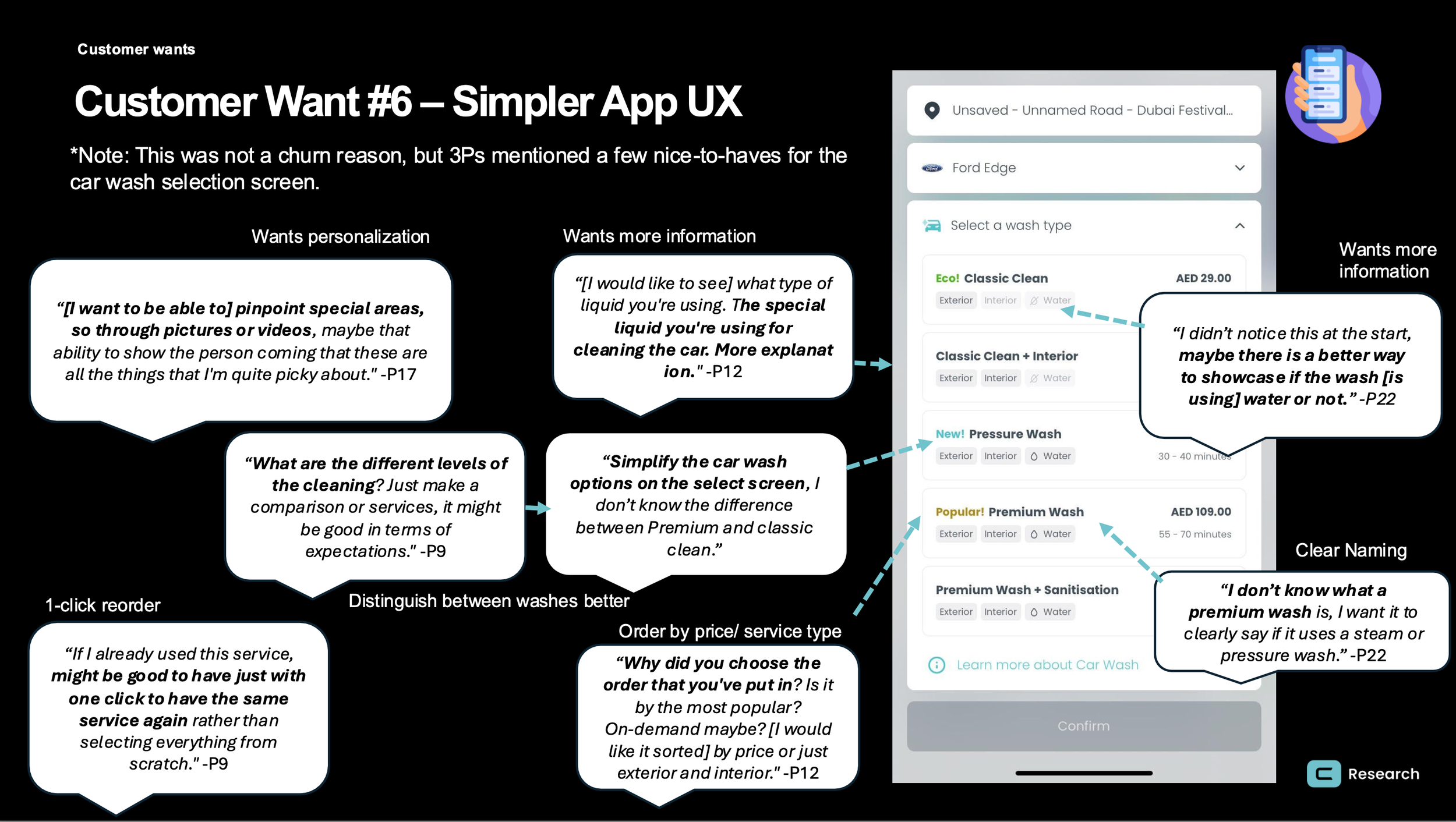
Before — user feedback mapped to the original selection screen.
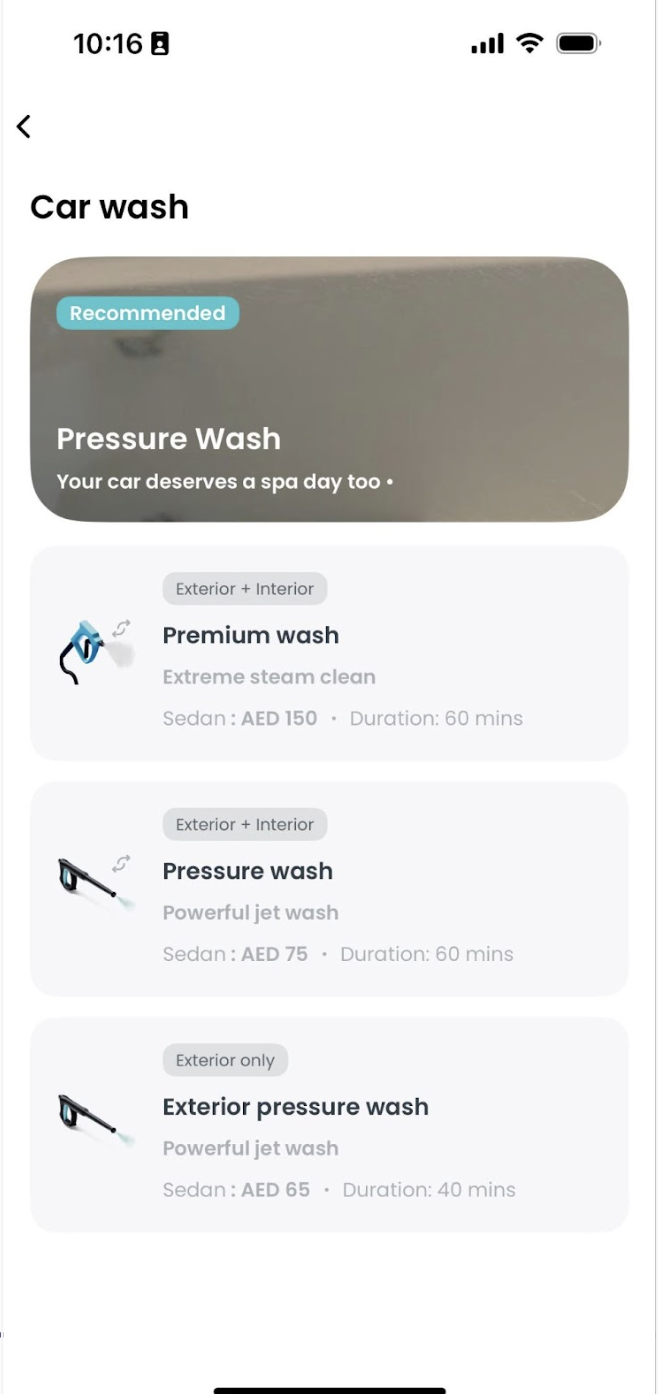
After — redesigned screen launched following research recommendations.
Impact
Research that moved product, operations, and the business
Strategic
- Interior cleaning repositioned as CAFU's core differentiator over local cleaners — informed by finding that local cleaner loyalty was social, not just economic
- Pilot equipment upgraded and training standards strengthened — informed by field observations of what a premium service experience required
- Study seeded 4+ follow-on research projects across cross-sell, upsell, and repeat plan UX
- Extended UXR's influence into operational decisions alongside product ones — expanding the function's reach across the business
Product
- Car wash repeat plan feature shipped — directly from the habit-formation finding
- Car wash selection screen simplified and wash type naming revised — users could now distinguish between tiers and understand what each service included
- One-tap reorder introduced — reducing friction at the moment of decision
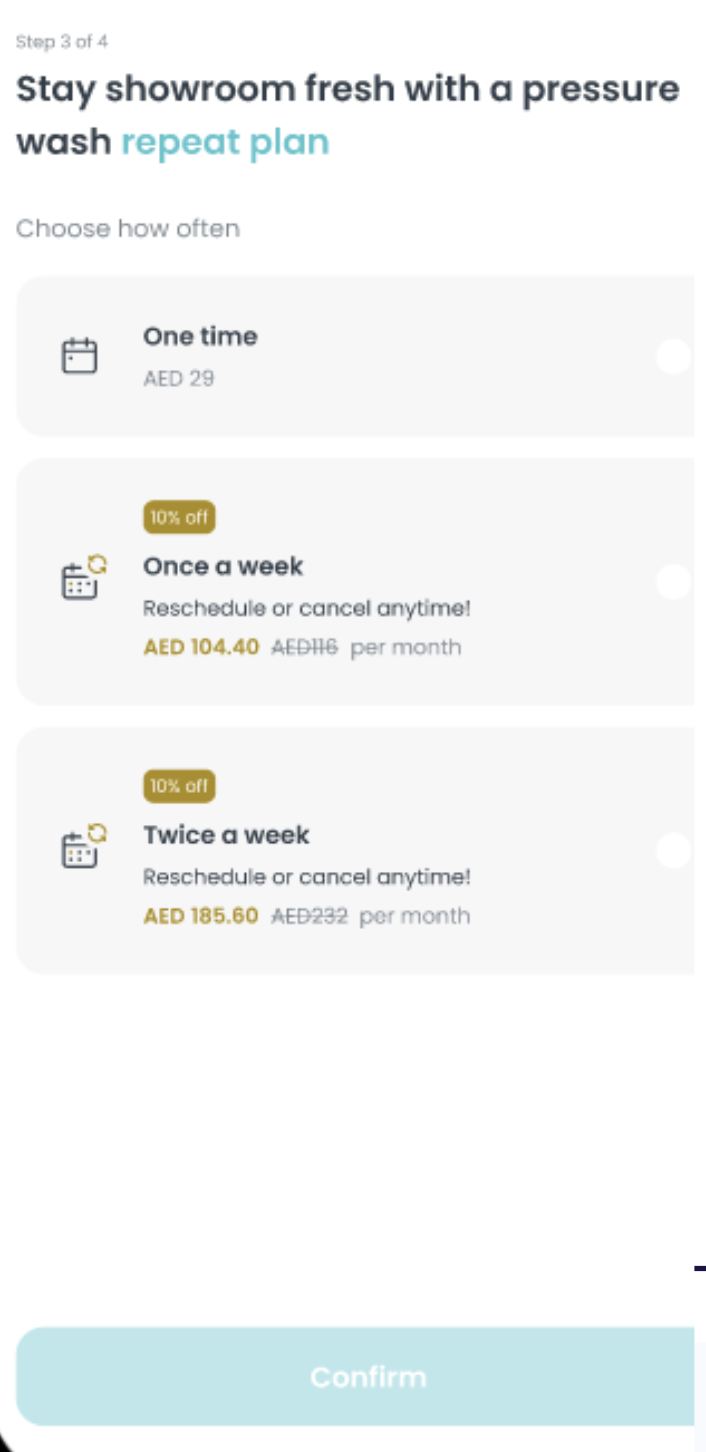
The car wash repeat plan — shipped directly from the habit-formation finding.
Business
- Pricing strategy adjusted based on competitive benchmarking and user research
- 5% retention increase measured over six months post-implementation
- Used internally as a model for connecting UXR to measurable business outcomes
What Colleagues Say
George Gliddon, Head of Product Design · CAFU
Alexey Pustotin, Product Manager · CAFU