Building research functions that earn trust
I build research practices in ambiguous environments — turning scattered learning into systems teams can use, trust, and sustain. This case study traces how I did that across CAFU and Jisr, through hands-on research, team leadership, and organizational design.
TL;DR
The challenge
Two companies at different stages — CAFU building its first UXR function during a major redesign, Jisr scaling an existing function post-Series A — both needing research embedded into how decisions actually get made.
What I did
At CAFU, built the first UX Research practice from zero — earning trust through useful research, running 50+ studies, and expanding the function into field empathy and service design. At Jisr, scaled an existing function into a structured operating model: hired a team, built intake, recruitment, and repository systems, and established Arabic-first research practices.
What changed
Research went from scattered to structural — easier to request, run, and act on. At CAFU the CAFU 2.0 redesign launched within 8 months. At Jisr, a team of 3 was hired and an operating model was in place within the same period.
Two Companies, One Pattern
Different markets. A similar challenge.
Two companies. Two markets. A similar pattern: customer understanding existed in pockets, but needed a more reliable path into decisions. In both places, I was brought in to build that path — with different constraints, at different organizational stages, and with very different starting points.
On-demand vehicle services — first UXR practice
A convenience layer for car ownership: fuel delivery, car wash, battery, tires, oil change, inspection, towing. Simple for the customer; complex physical service network behind it. I joined as the company's first UX Researcher, during a full app redesign, at an early stage of building the research function.
B2B HR tech SaaS — scaling a fragmented function
HR, payroll, attendance, performance, spend, talent, and workforce operations for Saudi and GCC businesses — roughly comparable to platforms like Rippling, ADP, or Workday, but built for Arabic-first users, Saudi/GCC compliance, and local payroll realities. Research existed when I joined post-Series A, and the opportunity was to scale it into a structured, organisation-wide function.
Chapter 1 · CAFU · UAE
Earning trust through useful research
At CAFU, research had to earn its place in the pace of product work. I started where the team needed clarity most: usability questions, redesign tradeoffs, and user expectations that could shape near-term decisions. As teams saw research prevent missteps and sharpen decisions, they began bringing it in earlier — creating space to study the larger service system behind the app.
Building the Function
From zero to a research practice teams relied on
When I joined CAFU, I was the first UX Researcher — coming in during a full app redesign with an opportunity to build the research practice from the ground up. The design team was scaling rapidly, and the company was expanding from fuel delivery into a broader vehicle services platform.
I started where I could be immediately useful: usability tests on flows in progress, quick studies to clarify user expectations, research that helped designers make specific decisions without waiting weeks. Over time, the teams that had seen research prevent a bad decision started bringing it in earlier. Trust accumulated. And that trust eventually created space for deeper work.
Within 8 months of joining, the CAFU 2.0 app redesign launched. Research supported that cross-functional effort through continuous usability studies and decision support across the redesign cycle — helping teams move faster on the flows that mattered most.
The Proof Point
The study that turned research into shared empathy
The product and design teams were redesigning the pilot app — the tool CAFU's frontline workers used to manage orders, navigate, communicate with customers, and handle equipment across a full shift. The redesign was underway. What was missing was any grounded understanding of what that shift actually looked like from the inside.
I chose ethnographic methods because the problem wasn't that pilots couldn't use the app — it was that we didn't understand the real-world context the app existed in. A standard usability test would have been too narrow. We needed to understand what was happening around the interface, not just within it. Ride-alongs, WhatsApp diary groups, and a 186-person survey gave us that picture. I also brought Product and Design stakeholders into the field rather than briefing them after — because organizational empathy forms through shared experience, not through decks.
Ride-alongs
Observed pilots in real conditions — orders, navigation, equipment, customer communication — across 3–4 hour sessions with 11 pilots across Dubai.
WhatsApp diary groups
Captured real-time issues and feedback beyond scheduled sessions, giving us a longitudinal view pilots felt comfortable contributing to.
Survey validation
Distributed to all pilots; 186 responses helped us understand which qualitative themes held at scale and which were edge cases.
Documentary storytelling
Turned fieldwork into an empathy artifact and onboarding resource that traveled further than the insights deck — reaching parts of the org that would never join a ride-along.

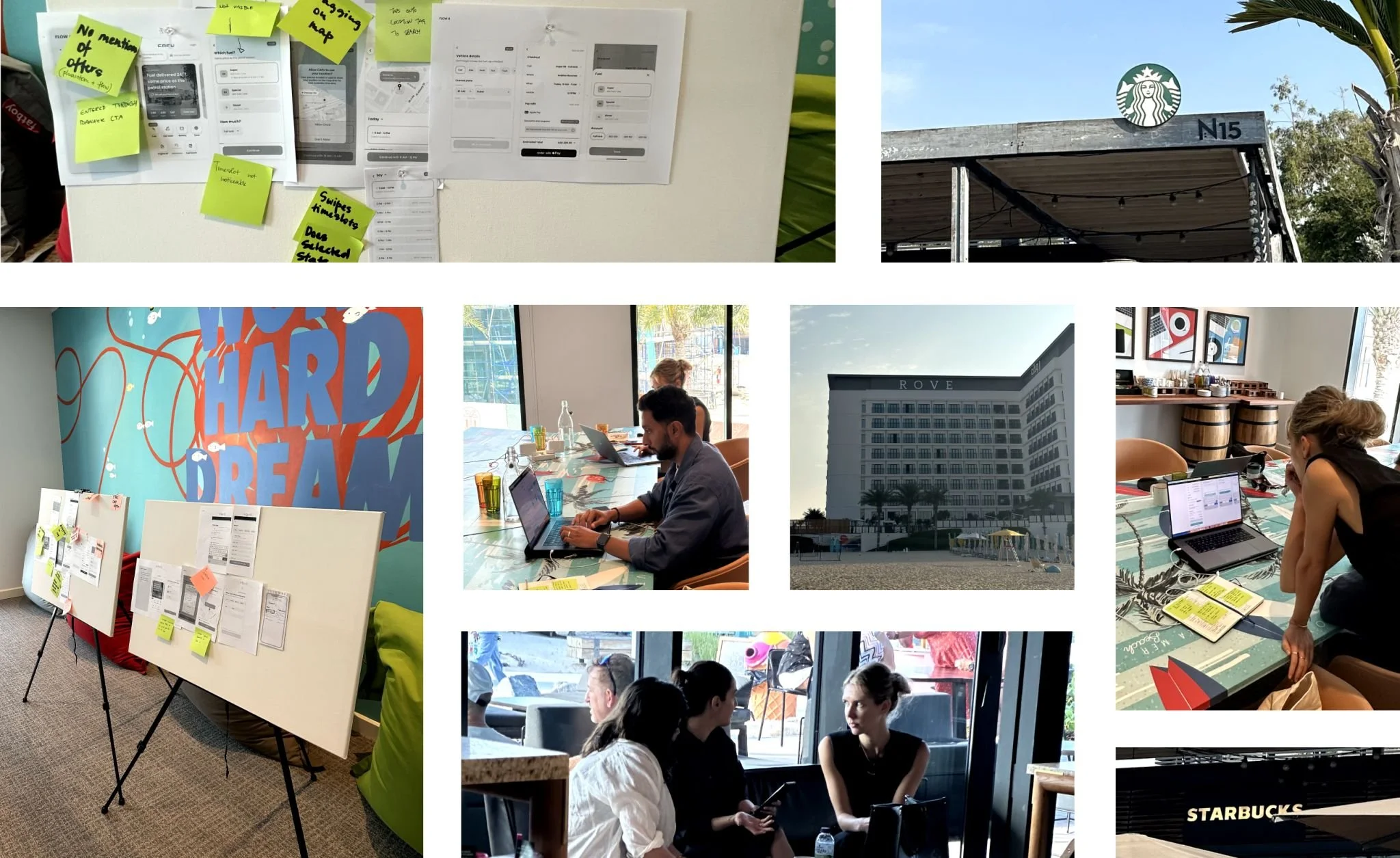
The team after a field session — synthesis and debrief as part of CAFU app research. Bringing Product and Design into the field built shared understanding that briefings alone never would.
Brainstorming and synthesis after a field session — working through what we observed before it fades.
The reframe
The app was one part of a service system nobody had fully mapped. Pilots were simultaneously managing navigation, order fulfilment, equipment, and customer communication across varied and unpredictable real-world conditions. The factors shaping service quality extended well beyond the screen — and no screen review would have surfaced them. This shifted the design question from "how do we improve the pilot app?" to "how do we design a service experience that works for pilots in the actual conditions of their work?"
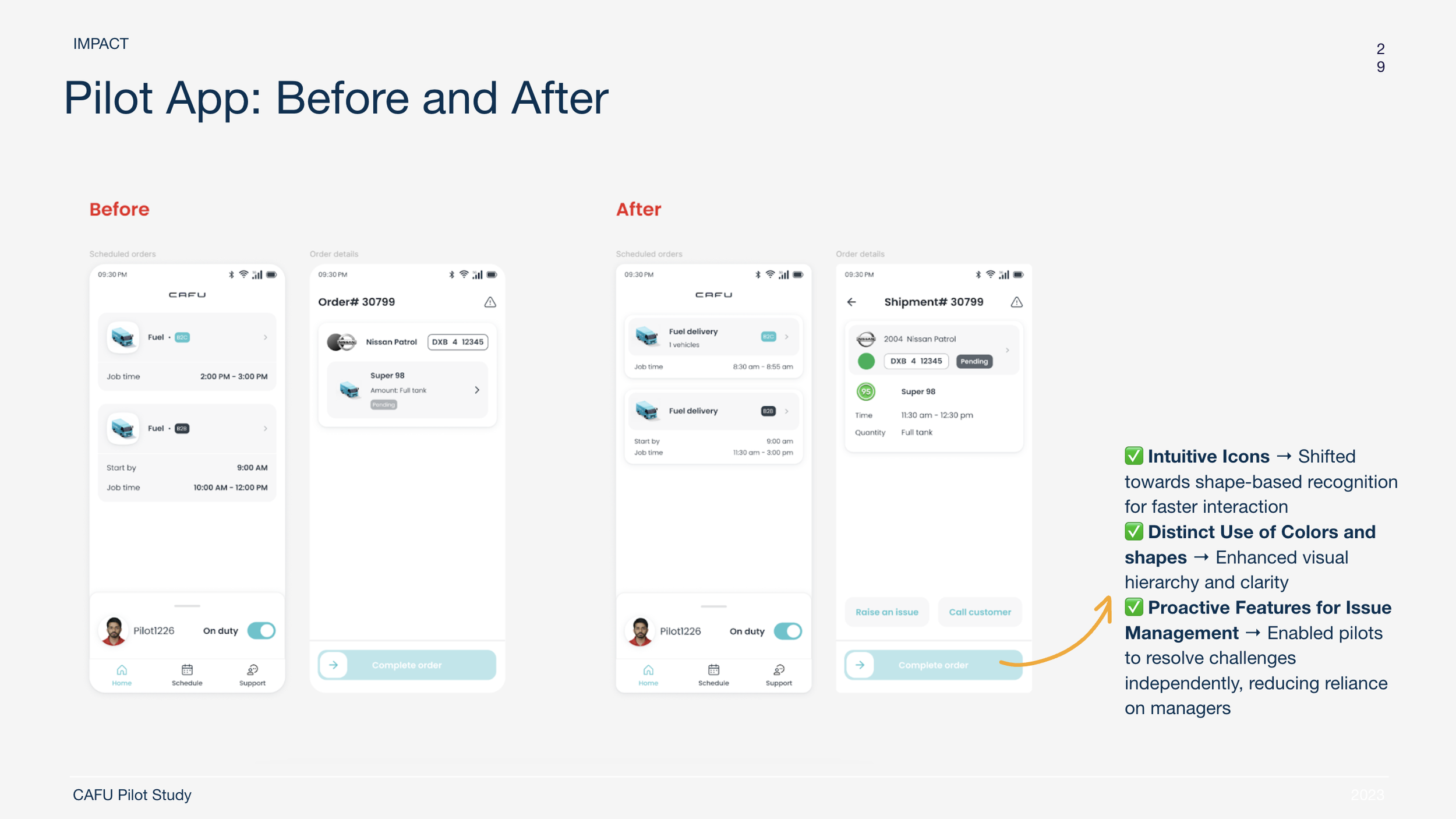
Pilot app before and after — intuitive icons, clearer visual hierarchy, and proactive issue management features, all informed by what we observed in the field.
What this proved about UXR at CAFU
The pilot study showed that UXR could do more than test screens. It could help teams understand the service system behind the product, build empathy for frontline workers, and create artifacts that kept teaching after the readout. Research became something stakeholders participated in, not just something they consumed.
Chapter 2 · Jisr · Saudi Arabia / GCC
Scaling research into an operating system
What CAFU taught me about earning trust through usefulness, Jisr asked me to operationalize at scale. Buy-in is not the same as an operating model — and building one while hiring a team and running active research is where the real work begins.
What I Built
A research operating system — built for Jisr's actual constraints
When I joined, one junior researcher was supporting more than 20 product and design teams, with limited shared intake, standards, or repository practices. Over the following months, I moved that into a structured function teams could rely on. The brief was genuinely complex: multi-product B2B SaaS across HR, Payroll, Attendance, Performance, Spend, Talent, and Platform; Arabic-first research with real tooling gaps; high-trust B2B recruitment through Customer Success and Adoption teams.

The strategic framing I brought to Jisr: UXR as the listening engine for adoption, enterprise readiness, localization, and multi-product fit.
Research strategy and roadmap
Framed UXR as Jisr's listening engine: customer understanding, decision confidence, speed to insight, and cultural nuances competitors overlook. Built a roadmap connecting research to Jisr's most important needs — adoption, retention, enterprise readiness, localization, and continuous discovery — shifting UXR from a reactive service to a strategic capability.
Team model: 2 UXRs + 1 Research Ops
Expanded from one junior researcher to a structured function with two UX Researchers and one Research Ops specialist. Each researcher owned specific product tribes. Research Ops handled recruitment, scheduling, consent, and logistics — protecting researchers' time for actual research. I treated intake as one of the first scaling problems, because adding researchers without shared structure would have accelerated fragmentation, not fixed it.
Intake and prioritization
Created a standardized intake that helped teams name the decision at stake, not just the research question. That distinction matters — "we want to understand users" is not researchable; "we're deciding whether to add X in Q3 and need to know if managers understand the proposal" is. The intake moved research upstream and made it possible to prioritize across competing requests with a shared framework.
B2B recruitment — coordination as trust protection
In B2B SaaS, research participants are customers. I created workflows that coordinated all outreach through Customer Success, built timing awareness around key business cycles, and established clear guidelines for when to pause recruitment to protect customer relationships. In Saudi B2B contexts, trust, recognition, and high-quality relationships often matter more than generic monetary incentives. Recruitment was a trust design problem, not a logistics problem.
Arabic-first research practice
Arabic-first research shaped more than the language of the interview — it shaped recruitment, moderation, materials, synthesis, and how findings traveled back to bilingual or English-speaking product teams. Most research infrastructure was built for English-language, Western B2B contexts, and the tooling gap is real. My role was to build the team and workflows that made Arabic-first research possible: partnering with and hiring Arabic-speaking researchers, creating bilingual materials, and establishing translation practices that helped local customer realities reach product decisions.
Training, handbooks, repository, and visibility rituals
Built the UXR charter, handbook, and central insight repository. Ran enablement workshops for Product and Design stakeholders on interviewing users, planning research, and moving from discovery to validation — creating self-service guides like the UXR 1-pager and a research platform handbook to support responsible lightweight research. The goal was not to make everyone a researcher, but to raise research literacy and help teams involve UXR earlier. Established research visibility in business reviews, design reviews, and product rituals — creating more moments where evidence could enter decisions.
Impact
What changed
At CAFU, research became a trusted function
I built and led CAFU's UX Research practice, supported the CAFU 2.0 redesign through 28 usability studies, and built trust through 50+ studies across redesign, retention, growth, expansion, and service experience. The work helped teams bring research into decisions earlier and expanded UXR beyond screen validation into field empathy and service understanding.
At Jisr, research became a scalable operating model
Over an 8-month period, I moved Jisr from one junior researcher into a structured function with 2 UX Researchers, 1 Research Ops specialist, shared intake, recruitment workflows, training, self-service guides, repository practices, and Arabic-first research principles.
Across both, research became more durable
The biggest shift was from individual studies to organizational learning: research became easier to request, easier to run, easier to act on, and easier to reuse — through artifacts like documentaries, personas, journey maps, handbooks, repositories, and rituals that outlived the studies that produced them.
What Colleagues Said
“If you’re looking for a UXR expert, look no further. Fariha’s a great addition to any research-driven product team — combining a sharp mind with genuine empathy for users. And she’s a joy to work with.”Abhishek Bhoite · Product Designer · CAFU
“Her exceptional communication and collaborative tone made her a joy to work with, and her ability to translate findings into clear, strategic recommendations elevated every project she touched.”Shumaila Batool · Senior Product Manager · CAFU
“Fariha is an exceptional manager who creates an environment where people can grow, do great work, and push themselves to a higher standard. She brings an exceptionally high level of rigor to every part of the discipline — from research plans to execution, reporting, and operations — and applies it effectively in fast-moving scale-ups where maintaining quality while moving quickly is a real challenge. She’s also an excellent coach and collaborator, with a rare ability to teach, simplify, and elevate the people around her while remaining grounded and patient. I would strongly recommend her to any team looking for a UX Research leader who can raise the bar, strengthen the function, and help transform the way product teams think about research.”Ritvik Kumar · UX Researcher · CAFU
Reflection
What this changed in how I lead research
Research maturity is not just about methods. It is about organizational readiness.
At CAFU, the question was: how do you build trust in research when the function is new? The answer was repeated usefulness — helping teams make better decisions in the rhythm of their actual work, then using that trust to take on deeper service questions.
At Jisr, the question changed: how do you scale research once leadership already believes in it? The answer was infrastructure — intake, prioritization, recruitment, team ownership, documentation, and rituals that made research easier to use across a growing product organization.
Across both contexts, I learned that local context is not a configuration setting. B2C service research in the UAE required different muscles than Arabic-first B2B SaaS research in Saudi Arabia. The tools, incentives, relationships, and timing all had to adapt to the market.
Rigor, documentation, and storytelling matter. But they only become valuable when they change what gets built.