Rebuilding the information architecture of an enterprise HR platform
Jisr is a Series A HR, payroll, and talent platform built exclusively for businesses in Saudi Arabia (KSA) — think Rippling, purpose-built for Saudi labor law. This is the story of redesigning its Settings experience for 10,000+ enterprise admins who could no longer find what they needed.
TL;DR
The problem
Jisr's Settings had grown with the product, not the user. As each squad added configuration items during rapid expansion, the structure drifted from how admins actually work. Behavioural data showed a clear navigation problem: users were cycling back to the main Settings page repeatedly within the same session.
What I did
Led a two-phase IA study across usability testing, tree testing, and card sorting. Managed the research team, directed synthesis across all three methods, and drove recommendations through a weekly cross-functional loop with service design, content design, and product.
The outcome
Research directly shaped every product decision — from restructured groupings to rebuilt search to revised terminology. The findings became the brief. A new Settings IA shipped to 10,000+ enterprise HR admins across Saudi Arabia. 99.27% chose to stay on the new navigation, a signal that the structure finally matched how admins actually think.
The Problem
Settings built for the product, not the admin
As Jisr expanded from payroll into attendance, leaves, performance, and talent, Settings grew by accretion. Each squad added its configuration items to whichever existing category felt closest — a natural consequence of rapid growth that created an opportunity to realign the structure around how admins actually work.
Behavioural data pointed to a clear navigation problem before we ran a single session: users were cycling back to the main Settings page repeatedly within the same session — a pattern that pointed to systematic findability issues, not isolated confusion.
Our research question: where exactly does the current structure break down, and what grouping would match how HR admins actually think?
My Role
Research lead across a cross-functional team
As research manager, I set the direction — the research questions, the method sequence, and how findings came together into a single recommendation. The researcher I managed brought that to life: she wrote the discussion guides, facilitated every session in Arabic and English, and drafted the reports. I shaped, challenged, and connected her work to the broader team throughout.
This was cross-functional work throughout — research, service design, content design, and the PM working in a shared loop from the first week to the last. Each discipline fed the next, and the weekly cadence meant decisions were made together, not handed off.

The Settings page before the redesign — nine categories in a flat card grid that had grown alongside the product. No hierarchy, no quick access. Every admin started from scratch on every visit.
Research Design
Two phases: diagnose, then validate
Phase one used usability testing and tree testing to map where the current IA failed and why. Phase two used card sorting to test whether a new grouping structure would work — before anything was built.
Usability Testing · Phase 1
Remote, moderated. Participants completed common admin task scenarios in the live Jisr environment. All sessions conducted in Arabic. Five sessions were enough to surface the dominant navigation failure patterns — and the timeline required moving quickly to the larger-scale tree test.
n = 5Tree Testing · Phase 1
Unmoderated, remote via UserQ. Participants navigated a text-only version of Settings to complete task scenarios. Two rounds — the second added tasks surfaced from usability findings.
n = 26Card Sorting · Phase 2
Fully moderated sessions via Google Meet. Participants sorted all Settings items into categories and explained their reasoning. Tested four candidate groupings (A–D) proposed by content design based on phase one findings. Eight sessions surfaced clear consensus on groupings — with strong agreement emerging by session five, the remaining sessions confirmed and stress-tested the pattern.
n = 8Who we spoke to
Usability test — HR admins from Saudi-based companies across different sectors, plus internal Jisr employees. Internal users are real power users who know the system deeply — useful for surfacing expert-level friction. External users brought real-world perspective.
Tree test — HR admins, specialists, directors, and assistants screened via survey and recruited through UserQ. UAE and KSA were combined as recruitment markets — HR admin personas are closely aligned across both regions, which expanded the pool without compromising relevance.
Card sort — HR and Finance admins, managers, and specialists from companies across the region.

Tree test results — task success rates across two rounds. Success rates varied significantly across Settings categories, with some tasks showing near-zero findability in round one. Data like this anchored the case for structural change.

Content design's four candidate grouping structures — developed in response to phase one findings and handed to the research team to validate through card sorting.
Why this sequence
Jumping straight to card sorting would have let us test a new structure without understanding why the old one failed. Usability testing gave us the qualitative picture — where admins got lost, what they expected, what confused them. Tree testing gave us task-level success rates and forced-choice data on where admins actually looked. Only then did we have enough to ask content design to propose groupings worth testing. The card sort validated those against real mental models before a line of code was written.
AI in this project
Arabic was the primary language for this study — all usability sessions were conducted in Arabic, and synthesis needed to reflect that. Transcripts were loaded into Dovetail for Arabic-English conversion, then passed through an LLM to extract and cluster themes — turning hours of session notes into structured, synthesis-ready output the team could work from directly.
AI also came in earlier: helping stress-test usability task wording for clarity and neutrality before sessions ran, and helping frame findings into the format the cross-functional team needed to act on them quickly. The result was a faster synthesis cycle without sacrificing the rigour of bilingual, moderated research.
Key Findings
The structure followed product logic — admins think in tasks
Most failure points traced back to a common pattern: Settings was organized around Jisr's internal suite structure, not the way an HR admin organizes their work.
🗺️ Admins couldn't find things they knew existed
Every session followed the same pattern: open a category, not find what you need, back out, try another. The business trip policy was the starkest case — it lived in Payroll, but every admin looked in Requests or Expenses because that's where travel policy belongs in their mental model. Zero participants found it in tree testing.
🔀 One task, multiple locations — workflows were split across unconnected sections
Setting up a leave policy end-to-end meant visiting two completely separate sections — creating the policy in one place, then configuring who approves it somewhere else entirely. Admins knew something felt wrong but couldn't name it until we watched them do it. The frustration wasn't the steps. It was not knowing whether they'd finished.
🏷️ Labels used system language, not admin language
When a label doesn't match the task, admins assume they're in the wrong place — and leave. "Leave Type" was read as a simple category name; admins expected "Policy" because they were setting eligibility rules. In Arabic, the word used for "Integrations" was technical jargon that HR users didn't recognize at all. Terminology was quietly breaking findability before navigation even started.
🔍 Search was the fallback — and it needed work
When navigation failed, almost every admin reached for search. Results weren't returning what users expected for common terms. In a complex B2B platform, search isn't a convenience — it's the recovery mechanism when the IA breaks down. Improving search would amplify every other findability improvement.
✅ Card sorting confirmed what worked — and surfaced what was missing
Seven of eight participants independently created the same category that didn't exist in the current IA — a single home for all company policies. They were tired of hunting for overtime rules in one section, travel policy in another, excuse hours somewhere else. Card sorting also confirmed that several existing groupings were already well understood and didn't need to change: Organization, Attendance, Leave, Payroll, Requests.
The Redesign
What each finding became
How findings were shared
Findings were delivered in two dedicated readout decks — one for the usability and tree test phase, one for card sorting — presented to the cross-functional team including content design, service design, and the PM. Each deck mapped findings to prioritized recommendations. The weekly cadence meant the team was already familiar with emerging themes by the time the formal readouts happened; the sessions were less about surprise and more about alignment on what to act on first. Before anything shipped, research findings and the proposed IA were presented to senior product and design leadership for sign-off.
Shipped
The new Settings shipped in both English and Arabic.
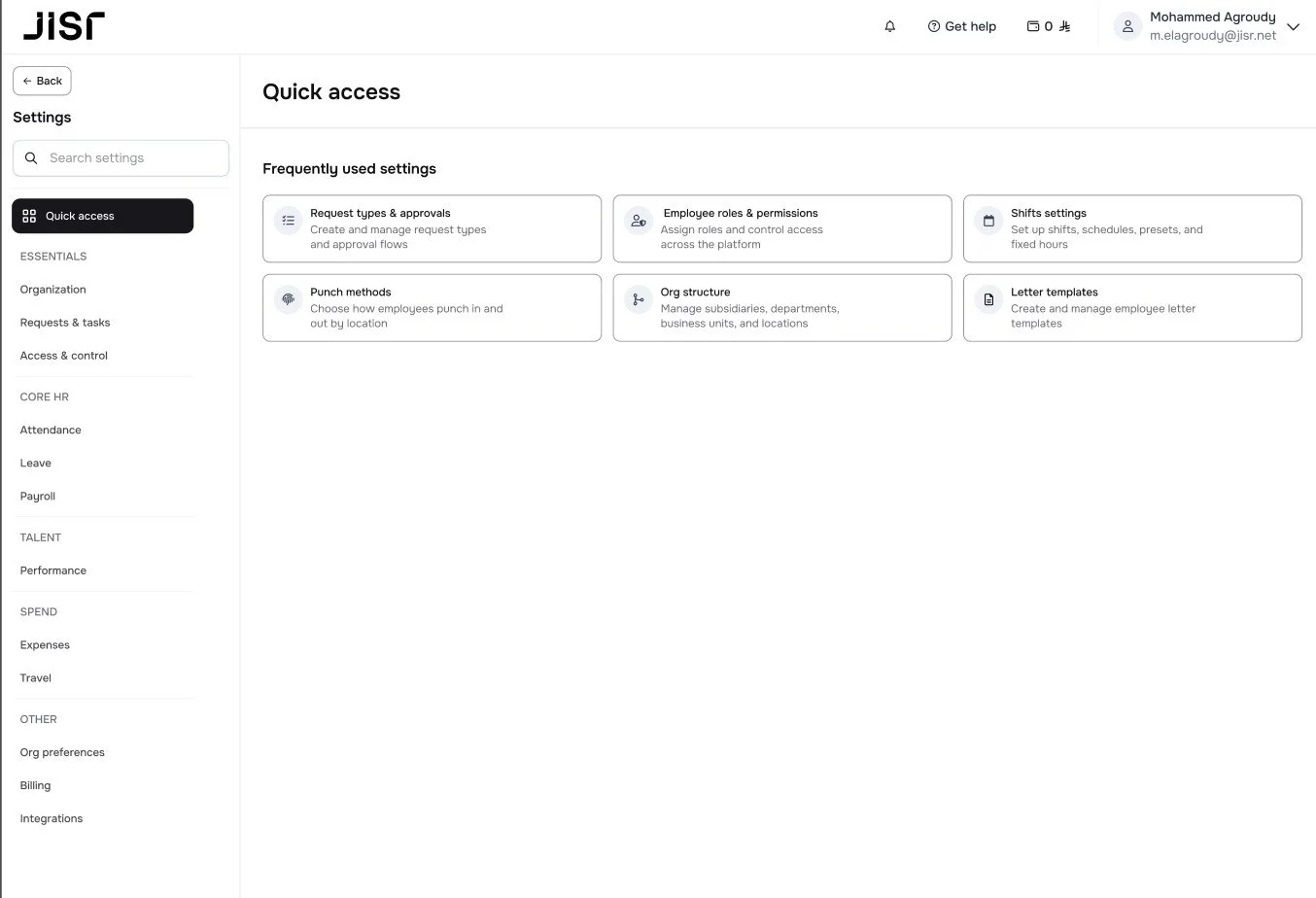
New sidebar navigation — task-based groupings with quick access.

Rebuilt search with breadcrumb-aware results.

Arabic version with full RTL sidebar navigation.
Impact
The new IA shipped to 10,000+ admins.
Every change traced back directly to a finding. The findings became the brief. Launched in February 2026 as an opt-out migration — every existing enterprise admin received the new IA by default.
reversion rate across 10,000+ unique admins since launch.
For an enterprise-wide migration of this scale, 99.27% staying on the new navigation is a strong signal the structure finally matched how admins think.
The grouping structure was also designed to scale — as Jisr adds new modules, the Essentials / Core HR / Talent / Spend framework gives each one a clear home without requiring another full IA overhaul.
Jisr enterprise user · February 2026