Informing Google Lens Multisearch: An Early Concept Study
An early-stage concept study exploring how people understood and wanted to use a then-new way of searching — using text and images together. The feature launched publicly in April 2022.
TL;DR
The question
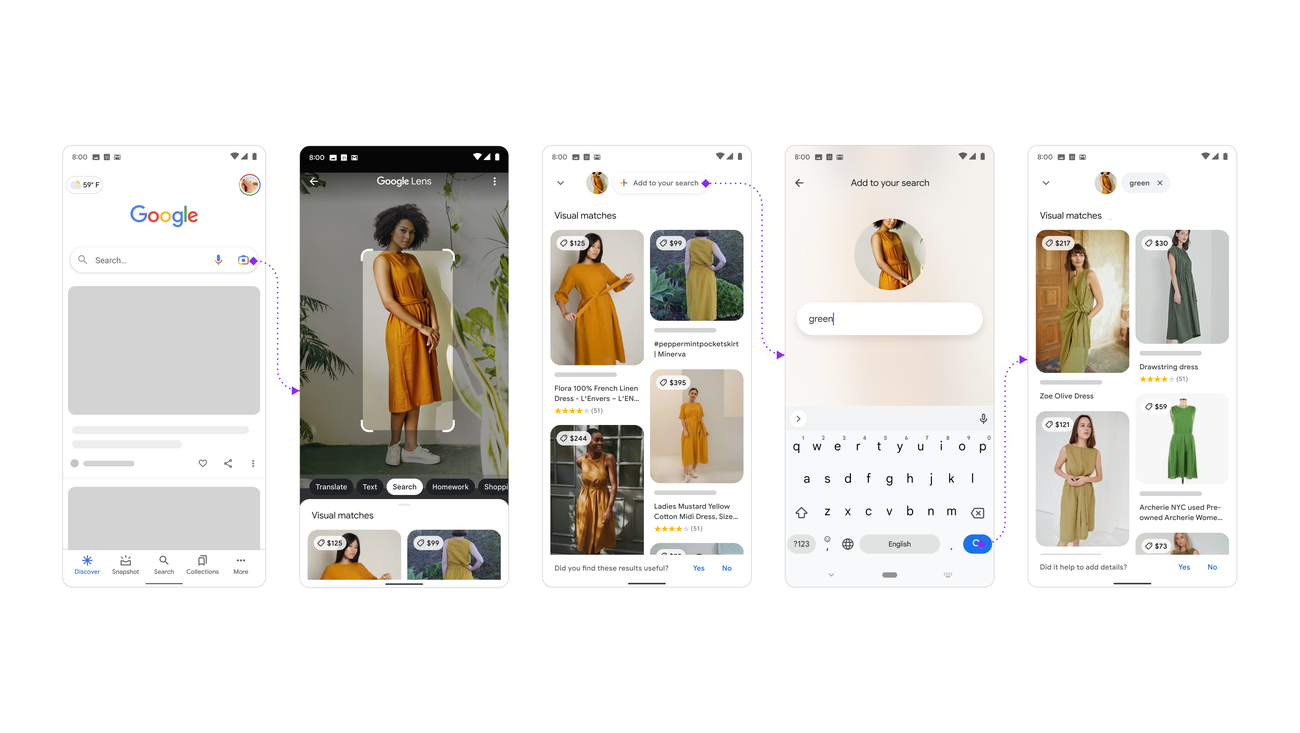
Google Lens could already search with images. But what if you could add words to that image search — to find the same dress in green, or that chair in oak? Would users understand this, and would they want it?
What I did
Executed an early concept study end-to-end under senior guidance — running 13 unmoderated cognitive walkthroughs, coordinating across a cross-functional team of 15+ spanning product, design, engineering, and UX writing. Delivered insights within a 3-week window and kept the xFN team engaged throughout via async video clips and early signal updates.
What followed
The study became one of the starting points for Multisearch. Findings shaped how the team thought about discoverability and onboarding ahead of the 2022 launch. The feature launched publicly in April 2022.
The Context
A feature that didn't have a name yet
The Google Lens team was exploring a concept that would let users search the web using text and images simultaneously — a capability that didn't exist yet in any form people were familiar with. They had developed early UX concepts and needed to understand a fundamental question: would users understand what this was, and would they want to use it?
This study was one of the first to put those early concepts in front of real users — before the feature had a name, before it had been validated.
My Role
Executing end-to-end under senior guidance
As a UX Research Associate embedded on the Google Lens team, I executed this study end-to-end under the close guidance of the Staff UXR who managed me on this project — handling planning, recruitment coordination, study setup, moderation, analysis, and results presentation within a 3-week window.
The broader xFN team was 15+ strong, spanning product, design, engineering, and UX writing. With no live viewing stream, I kept the team engaged through async updates — sharing video clips, early signal, and discussion starters throughout the study rather than waiting for the final readout.
The Problem
How do you test something users have never seen before?
Searching with text and images simultaneously had no precedent in how people thought about search. The challenge wasn't just building the feature — it was ensuring people could discover it and understand its value without being told.
The core tension was between comprehension and discoverability — if you over-explain a feature, you've already failed at making it feel natural. The research needed to find that line: what was intuitive, where users got lost, and what required onboarding versus what could be self-evident.
We needed to answer: do users understand what Multisearch does? Can they find it? And which use cases feel valuable enough to make them want to try it?
Research Design
An unmoderated cognitive walkthrough — and why the team chose this approach
With a 3-week turnaround and a large cross-functional team waiting on findings, the method choice mattered as much as the questions. The Staff UXR leading the project selected a remote unmoderated approach, and I designed and executed the study within that framework — participants walked through early UX mocks step by step, sharing their thoughts and expectations as they went.
Cognitive Walkthrough
Participants were shown early UX mocks of the Multisearch concept via links in the platform. At each step they were asked to share their thoughts, expectations, and what they thought would happen next — surfacing mental models in real time without moderator influence.
n = 13Remote Unmoderated
Sessions ran asynchronously via an unmoderated research platform on desktop devices — giving us the scale and speed a 3-week timeline required, while still capturing rich qualitative data through think-aloud responses and open-ended questions at each step of the flow.
20 min sessionsWhy unmoderated for a concept this new
Moderated sessions would have given richer individual stories but at the cost of speed. For early-stage concept research where the goal was to map a range of mental models quickly, unmoderated was the right call for the timeline and team needs. The tradeoff — no ability to clarify in real time — meant investing extra upfront effort in making instructions airtight and the study flow as clear as possible before launch.
Analysis and synthesis
Participant think-aloud responses were reviewed step by step and coded in a spreadsheet — noting reactions, expectations, and points of confusion at each stage of the UX flow. Themes were grouped across participants to surface patterns in comprehension, discoverability, and use case resonance. Findings were synthesised into a presentation deck with supporting video clips and participant quotes, delivered to a cross-functional team of PMs, designers, engineers, and UX writers within the 3-week window.
Participants
Who we recruited and why
We needed participants familiar with Google Search, active online shoppers, and a deliberate mix of Lens and non-Lens experience.
Inclusion criteria
US-based. Mix of gender. Lens and non-Lens users included — to capture a range of reactions to a feature neither group had seen before.
Why online shoppers
Visual shopping — finding an item in a different colour, matching a style — was the primary use case the team was designing for. Recruiting active online shoppers meant participants would immediately have personal context for the scenarios they were evaluating.
Key Findings
What users understood, and where the design needed to go next
The study surfaced two clear signals: the core concept resonated, and the path to finding it needed work. Together they pointed the team toward where to focus ahead of launch.
✅ Mental models aligned more than expected
In most steps of the flow, what users expected to happen matched what the design showed — a positive signal for concept comprehension. The value of combining text and image clicked naturally, especially for shopping use cases.
🔍 Discoverability was the clearest design opportunity
Users who encountered the feature understood it — but the path to finding it in the first place wasn't yet intuitive, pointing to where the design needed to focus next.
🧭 Onboarding could amplify an already-understood concept
Participants who encountered the feature responded positively and grasped it quickly — the opportunity was in surfacing it earlier, not in explaining it more. The ask was "help me find it" not "tell me what it is."
❤️ Visual shopping drove the strongest positive reactions
Fashion and home goods use cases generated the most enthusiasm. Users immediately saw the value for finding items in different colours or matching styles — personal and concrete.
🤷 Non-visual and broad queries created ambiguity
When queries weren't inherently visual or were too broad, users were less certain about what to expect from results. The feature's value was strongest when anchored to a specific object in front of them.

Google Lens Multisearch — searching with text and images simultaneously. Source: Google Blog, April 2022.
Impact
From early concept to global launch
This was one of the first structured research studies on what became Multisearch. The discoverability opportunities identified here informed how the team approached surfacing the feature ahead of launch — ensuring users could find it, not just understand it.
Strategic
- Sparked cross-functional discussions on user mental models, behaviour, and value across a large xFN team
- Helped the team prioritise visual shopping as the anchor use case for the initial launch
Product
- Findings informed discoverability and onboarding design — surfacing where design attention was needed and what kind of guidance users were looking for
- Identified future use cases users mentioned organically, expanding the team's thinking beyond the initial visual shopping focus
- Seeded multiple further rounds of UXR that refined the experience ahead of launch
Launch
- Feature launched publicly in April 2022 in the US as a beta feature
- Feature available globally on the Google app across Android and iOS
Multisearch in action — the feature as it launched publicly in April 2022.